

Table of Contents
Comprehensive Guide to Business EV Charging Solutions | Turnkey & Custom Models
As electric vehicle adoption surges past tipping points globally, enterprise leaders, property managers, and fleet operators face a structural imperative: integrating commercial charging infrastructure. Investing in business EV charging solutions is no longer a fringe sustainability initiative; it is a core operational strategy that drives customer loyalty, optimizes fleet logistics, and unlocks new revenue streams.
Whether you manage corporate offices, retail complexes, multi-family residential communities, or commercial delivery fleets, understanding the nuances of hardware, software, business models, and site architecture is critical to maximizing return on investment (ROI).
1. The Strategic Value of Commercial EV Charging
Implementing EV charging infrastructure transforms passive real estate into an active, value-generating asset. Modern consumers and forward-thinking employees increasingly choose destinations based on charging availability.
- Enhanced Dwell Time and Foot Traffic: For retail centers, hospitality venues, and restaurants, offering EV charging encourages customers to stay longer, directly increasing spending per visit.
- Employee Recruitment and Retention: Modern corporate campuses that offer workplace charging signal organizational alignment with environmental values, serving as a powerful talent retention tool.
- Future-Proofing Real Estate Value: Properties equipped with scalable electrical and charging architecture command higher property valuations and remain competitive as internal combustion engine (ICE) phase-outs accelerate.
2. Core Hardware and Infrastructure Types
Selecting the correct tier of charging hardware depends heavily on user dwell times, spatial constraints, and electrical capacity.
| Charging Level | Power Output | Typical Use Case | Average Charging Speed |
| Level 2 (AC) | 3.1 kW to 19.2 kW | Workplaces, multi-family, fleet overnight depots, retail | 15 to 30 miles of range per hour |
| DC Fast Charging (DCFC) | 50 kW to 350+ kW | Retail highway corridors, commercial fleet quick turnaround, gas stations | 80% charge in 15 to 30 minutes |
| Megawatt Charging Systems (MCS) | 1,000+ kW (1 MW+) | Heavy-duty commercial trucking and logistics depots | Full charge for heavy trucks within a 45-minute driver break |
3. Comprehensive Business Models & Turnkey Aggregating
Navigating the financial and logistical complexities of deployment requires partnering with the right service frameworks. The market relies on several established operational models:
Charging-as-a-Service (CaaS)
Under a CaaS model, a third-party provider or Charge Point Operator (CPO) handles the upfront capital expenditure (CapEx), installation, network management, and ongoing maintenance. The host business pays a predictable subscription fee or shares a portion of charging revenues. This model removes technical friction and shifts risk away from the property owner.
Turnkey Deployment
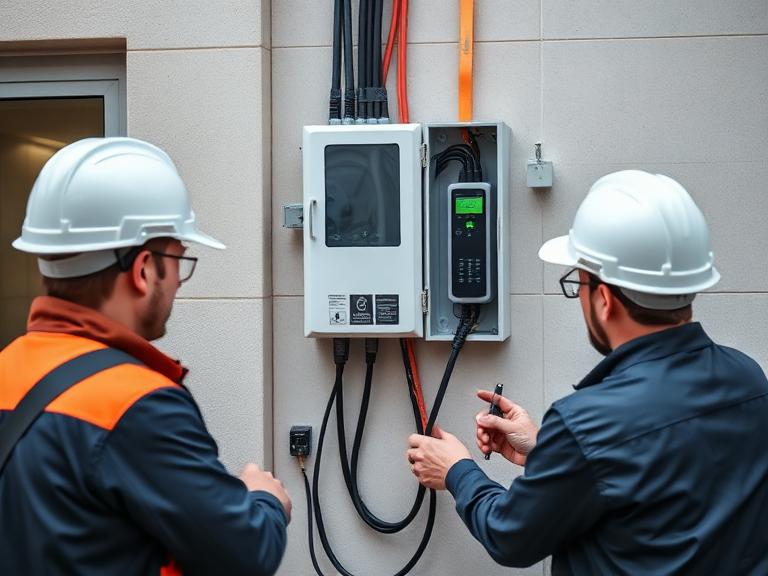
Turnkey solutions offer an all-inclusive framework spanning site evaluation, local utility coordination, permitting, hardware procurement, civil engineering, electrical construction, and software configuration. This end-to-end approach guarantees compliance with regional electrical codes and accelerates time-to-market.
Asset Aggregation and Multi-Site Management
For businesses operating nationwide or across regional footprints, aggregation platforms centralize management. They pool energy data, optimize load balancing across multiple facilities, and streamline payment processing, billing reconciliation, and driver support into a single dashboard.
4. Frequently Asked Questions (15 FAQs)
1. What are business EV charging solutions?
Business EV charging solutions refer to comprehensive packages of hardware, software, installation services, and ongoing maintenance tailored for commercial properties, workplaces, and fleets to support electric vehicles.
2. How do commercial Level 2 chargers differ from DC fast chargers?
Level 2 chargers use alternating current (AC) and are ideal for locations where vehicles remain parked for hours (workplaces, apartments). DC fast chargers supply direct current (DC) at much higher power levels, designed for rapid top-ups along transit routes or fast-turnaround fleet operations.
3. What is a “turnkey” EV charging solution?
A turnkey solution is an end-to-end service package where a specialized provider manages every phase of the project—from initial site design, utility interconnection, and permitting to construction, hardware installation, and software commissioning.
4. What is Charging-as-a-Service (CaaS)?
CaaS is a business model where a third party owns, operates, and maintains the charging infrastructure. The host business avoids high upfront capital costs and instead pays a predictable operational fee or shares revenue.
5. Can my business make money from EV charging stations?
Yes. Businesses can monetize chargers by setting flexible fee structures (e.g., per kWh, per hour parked, or subscription models) or by attracting higher-value customers who spend more time and money on-site while charging.
6. How do I handle grid constraints and high utility demand charges?
Many commercial deployments incorporate battery-buffered energy storage systems (BESS) and smart energy management software. These tools flatten peak loads, draw power during off-peak hours, and prevent expensive demand spikes from utility providers.
7. What software is required to manage commercial chargers?
Commercial stations rely on a Charge Point Management System (CPMS) using open protocols like OCPP (Open Charge Point Protocol). This software allows remote monitoring, pricing adjustments, user access control, and payment processing.
8. Are EV chargers compatible with all electric vehicle models?
Most commercial Level 2 and DCFC chargers utilize standardized connectors (such as CCS, NACS, and J1772) that accommodate the vast majority of modern electric passenger cars and light-duty commercial vehicles.
9. What are the tax incentives and grants available for business EV charging?
Governments at local, state, and federal levels frequently offer tax credits (such as Section 30C in the U.S.), rebates, and grants to offset the purchasing and installation costs of commercial charging hardware.
10. How long does it take to install commercial EV charging stations?
Timelines vary widely based on utility coordination and local permitting. Simple Level 2 projects may take 4 to 8 weeks, whereas complex DC fast-charging installations requiring major grid upgrades can take 6 to 18 months.
11. Who is responsible for maintenance and repairs?
Under turnkey or CaaS models, the service provider handles 24/7 monitoring, preventive maintenance, and repairs. If you own the hardware outright, you can contract a service-level agreement (SLA) with a certified local provider.
12. Can I restrict charger access to employees or specific customers only?
Yes. CPMS software allows administrators to configure access control lists (ACLs)—enabling free charging for employees via RFID badges or apps while charging a fee for general public users.
13. What is Load Balancing and why is it important?
Dynamic load balancing distributes available electrical capacity evenly across multiple active charging ports. This prevents overloading the building’s electrical panel when many vehicles plug in simultaneously.
14. How do multi-family apartment complexes handle billing for EV chargers?
Multi-family properties typically use networked Level 2 stations where individual residents authenticate via app or RFID card. The billing system automatically bills the specific user’s account for the exact electricity consumed.
15. What role does artificial intelligence play in modern EV charging?
AI-driven energy management platforms forecast energy demand, optimize charging schedules according to fluctuating utility rates, mitigate peak grid strain, and predict hardware maintenance needs before failures occur.