

Table of Contents
Stuck Lift Door Repair in Gachibowli | Emergency Elevator Fixes
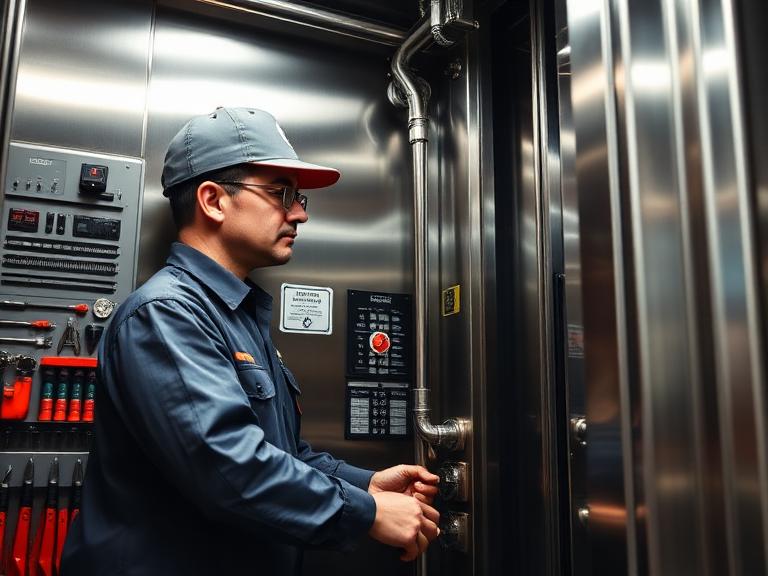
A stuck lift door is more than an operational headache—it is a critical safety issue that halts daily activity. In Gachibowli’s high-traffic IT parks, financial centers, and premium vertical residential societies, elevator doors operate under relentless cycles. When a door jams halfway, locks permanently in a closed position, or continuously bounces back without closing, the underlying issue could range from mechanical wear to complex electronic control faults.
Resolving a stuck lift door requires an understanding of how mechanical alignment, physical tracks, electronic sensors, and digital controller states interact. This technical manual details the root causes of elevator door failures, safety rescue protocols, and engineering fixes to keep vertical transportation systems running reliably.
1. Why Lift Doors Get Stuck: Root Mechanical & Electrical Causes
Elevator door mechanisms are designed to prioritize passenger safety above all else. If the central processing unit (CPU) detects any variation in operating voltage, resistance, or physical alignment, it locks down the entire system. Understanding these failure modes helps narrow down the problem during an inspection.
                  [STUCK LIFT DOOR UNDERLYING MECHANISMS]
                                     │
     ┌───────────────────────────────┼───────────────────────────────┐
     ▼                               ▼                               ▼
[Mechanical Jams]            [Electrical Faults]             [Logic Failures]
• Silt/Debris Blockages      • Safety String Interrupts      • VVVF Profile Drift
• Hanger Roller Drops        • Blown Gate Contacts           • Encoder Position Loss
• Distorted Track Rails      • Shorted Optical Curtains      • Limit Switch Stuck High
A. Mechanical Track Jams and Debris Obstruction
The bottom door tracks (sills) are a common point of failure for automatic sliding doors. In commercial spaces, heavy foot traffic continuously introduces dirt, small debris, and small items into the machined tracks.
- The Mechanism: When a door panel hits a solid object in the track, the Variable Voltage Variable Frequency (VVVF) operator motor encounters an immediate spike in physical resistance.
- The Result: The motor controller detects a sharp rise in current draw. To prevent injury or hardware damage, the system enters an error state—either reversing repeatedly or shutting down the door drive completely.
B. Mechanical Interlock and Hook Failures
Each landing door features a heavy mechanical interlock switch assembly that keeps the doors locked shut unless the elevator car is parked directly at that floor.Mechanical Hoistway Interlock and Safety Switch. Source: Elevator Vip
- The Mechanism: If the car cabin’s driving vane drops out of alignment due to guide shoe wear, it can fail to fully engage the hoistway landing rollers.
- The Result: The locking hook cannot clear its catch. The lift doors remain mechanically stuck closed, preventing passengers from exiting even though the car has reached the correct floor.
C. Electrical Safety Circuit and Gate Contact Openings
The elevator safety loop links all safety switches in a continuous series circuit. The car gate contact switch monitors the fully closed position of the inner cabin doors.
- The Mechanism: Constant vibration can loosen the mounting brackets on these sensitive switches, or the internal copper pads can become oxidized over time.
- The Result: Even when the door panels are physically closed, a loose or tarnished switch breaks the circuit. The central controller reads this as an open door and prevents the elevator from moving.
2. Emergency Passenger Extraction: Controlled Extraction Safety Standard
When an elevator gets stuck between floors with passengers inside due to a door mechanical failure, building staff must follow strict safety protocols. Uncontrolled or unauthorized extraction attempts can put passengers at serious risk.
Protocol Guidelines for On-Site Engineering Teams
- Isolate Primary High-Voltage Feeds: Turn off and apply lockout-tagout (LOTO) procedures to the main motor breaker in the machine room. This ensures the elevator cannot move unexpectedly if the controller suddenly resets.
- Verify Car Leveling Positioning: Check the position indicators on the hoistway cables or use digital floor readouts to confirm the car’s exact position relative to the nearest floor landing.
- Manual Car Leveling (If Stuck Between Floors): If the cabin is outside the safe leveling zone (±150 mm), use the manual brake release tool in the machine room. Carefully modulate the brake lever to let the counterweights drift the cabin smoothly to the nearest floor.
- Disengage Hoistway Interlocking Hooks: Insert a specialized triangular release key into the landing door’s emergency access hole at the target floor. Turn the key clockwise to manually lift the internal locking hook.
- Open Doors and Evacuate Safely: Slide the outer landing doors and inner cabin doors open by hand simultaneously. Secure the open doors mechanically before helping passengers exit safely.
- Keep System Offline for Repair: Keep the elevator powered down and closed to the public until a qualified service technician diagnoses and fixes the underlying failure.
3. Advanced Diagnostic Matrix: Locating Door Control System Faults
Modern elevator doors use closed-loop digital logic controllers. This matrix helps technicians systematically diagnose and isolate faults based on specific system behaviors.
Diagnostic Flow and Troubleshooting Parameters
| Observed Door Behavior | Indicated System Fault | Primary Testing Location | Target Voltage / Range | Recommended Action |
|---|---|---|---|---|
| Door will not move; controller displays a “Door Protection Timer” error. | Severed or slipping VVVF drive belt; dead operator motor. | Car-top door operator inverter terminal box. | 230V AC input / 0 to 110V DC output. | Replace worn timing belts; check motor windings for electrical shorts. |
| Doors close completely, but the lift will not move or accept calls. | Pitted or misaligned gate contact switch breaking the safety string. | Inner cabin door header switch enclosure. | 110V AC across safety circuit line. | Clean oxidized contacts using burnishing tools; reset mounting brackets. |
| Doors slide open freely, but bounce and shudder violently when closing. | Worn hanger rollers with flat spots; debris in the lower sill. | Upper header tracking bar / lower aluminum sill channels. | Mechanical check (Zero tolerance for tracking drift). | Replace worn rollers; clear track grooves using rigid steel brushes. |
| Doors remain held wide open; the controller shows a constant “re-open” signal. | Blocked or defective infrared multi-ray light curtain. | Vertical edge profiles of car entry frame. | 24V DC constant supply input. | Clean the optical lenses; verify alignment between receiver and transmitter. |
| Doors drift open slightly after closing fully, breaking the safety loop. | Weak or broken mechanical counterweight return spring. | Landing door header rear track drop mechanism. | Mechanical tension check (15 N to 30 N return force). | Replace fatigued torsion loops or adjust cable tension weights. |
4. Step-by-Step Technical Repair: Rebuilding a Failed Door Hanger Track
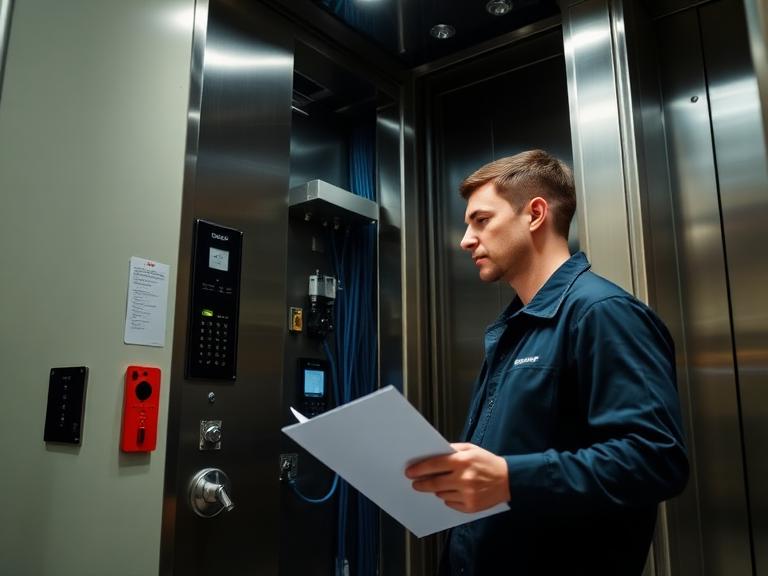
When an elevator door clunks, shudders, or jams halfway along its track, the upper hanger rollers and header bar typically need to be disassembled and rebuilt.
Calibrating Door Control Electronics. Source: Olympia Elevators Pvt. Ltd.
1
Mechanical Panel Stabilization
Action Step 1
1.Mechanical Panel Stabilization:Action Step 1.
Drive the car to a comfortable working height and lock out all electrical systems. Secure the heavy structural door panels with adjustable locking clamps anchored to the lower sill to prevent them from dropping out of the track during disassembly.
2
Eccentric Up-Thrust Roller Disassembly
Action Step 2
2.Eccentric Up-Thrust Roller Disassembly:Action Step 2.
Locate the eccentric up-thrust counter-rollers underneath the main header bar. Use an open-ended wrench to back off the locking fasteners, then rotate the offset shafts downward to create enough clearance to remove the door panel.
3
Header Bar Surface Restructuring
Action Step 3
3.Header Bar Surface Restructuring:Action Step 3.
Carefully lift the door panel out of the upper track and set it aside safely. Clean the solid steel tracking bar using a fine-grit abrasive cloth to remove built-up grease, rust, and flattened residue, creating a smooth surface for the new rollers.
4
Precision High-Performance Roller Installation
Action Step 4
4.Precision High-Performance Roller Installation:Action Step 4.
Unscrew the worn hanger rollers from the top of the door frame. Install new polyurethane-coated rollers with sealed precision ball bearings, tightening the mounting bolts to the manufacturer’s specified torque settings.
5
Vertical and Horizontal Clearance Calibration
Action Step 5
5.Vertical and Horizontal Clearance Calibration:Action Step 5.
Hang the door panel back onto the tracking bar. Adjust the eccentric counter-rollers upward until they sit exactly 0.15 mm below the bottom edge of the track rail to prevent excessive vertical movement.
6
Dynamic Test Runs and Velocity Re-Mapping
Action Step 6
6.Dynamic Test Runs and Velocity Re-Mapping:Action Step 6.
Remove all safety clamps, turn the main power back on, and put the controller into manual inspection mode. Run several test cycles to verify the doors glide smoothly and quietly before returning the elevator to normal service.
5. Preventative Modernization: Upgrading Aging Mechanical Door Drives
Many older buildings in Gachibowli still use mechanical linkage arms driven by old-style DC motors. These legacy setups are prone to frequent adjustments, noise, and mechanical wear. Upgrading to modern VVVF door control systems can improve reliability.
Advantages of Upgrading to Modern Door Technology
- Closed-Loop Digital Control: Modern VVVF systems use digital encoders to monitor the door’s exact position, velocity, and motor load in real time. This allows the drive to adjust motor torque dynamically, ensuring smooth operation regardless of wind tunnel effects or minor dust accumulation.
- Fully Custom Speed and Torque Profiles: Technicians can program multi-step speed curves to control acceleration, high-speed travel, and final slowdown cushioning. This keeps door cycles fast and efficient while protecting the mechanical components from harsh impacts.
- Improved Safety and Code Compliance: Modern conversions include built-in torque monitoring that limits door closing force to safe levels (under 135 N of kinetic energy). This reduces wear on mechanical components and prevents accidental injury to passengers.

6. Frequently Asked Questions (FAQs)
Q1: Why do elevator doors get stuck more often during seasonal weather transitions or high winds?
A: High-rise towers in areas like Gachibowli often experience the “stack effect.” This occurs when temperature differences between the inside of the building and the outside air create significant pressure deltas within the elevator shaft. This pressure differential acts like a wind tunnel, pushing against the large surface area of the door panels and causing them to bind or rub against their tracking guides during operation.
Q2: Can a building maintenance team apply standard lubricating grease directly to elevator door tracks?
A: No, standard lubricating grease or heavy oils should never be applied to the bottom door sill grooves or top header tracks. These sticky lubricants attract dust, lint, and grit, creating a abrasive paste that accelerates wear on the guide shoes and flattens hanger rollers over time. Tracks should be kept clean, dry, and free of residue.
Q3: What is the main cause of an elevator door continuously opening and closing at a floor landing?
A: This issue is typically caused by a malfunctioning infrared light curtain or a faulty electronic safety edge sensor. If a sensor light path is out of alignment, or if dust settles over the lenses, the system registers a constant obstruction. The controller responds by repeatedly opening the doors to protect passengers from a non-existent obstacle.
Q4: How long does a standard elevator door interlock mechanism last before needing a rebuild?
A: In high-traffic commercial environments, landing door interlock assemblies typically require a comprehensive overhaul or component replacement every 4 to 5 years. Over millions of cycles, the mechanical tracking rollers wear down, electrical contacts pit, and internal return springs lose tension, which can lead to intermittent safety circuit failures.
Q5: Is it possible for a lift door to open safely while the car cabin is moving between floors?
A: Modern elevator systems feature independent mechanical and electrical interlocks that prevent the doors from opening while the car is in motion. The landing doors remain locked by gravity-assisted steel hooks, and the car gate requires a mechanical engagement vane to activate. The system safety loop will instantly cut power to the main hoist motor if a door contact opens mid-travel.